When to Start Baby on High Chair

That first wobbly sit at the table can feel like a milestone and a minefield at the same time. If you are wondering when to start baby on high chair use, the short answer is usually around 6 months - but age matters less than readiness. A baby high chair works best when your baby can sit with good support, hold their head steady, and join family mealtimes safely.
For many parents, this question comes up just as solids are starting. You are buying bowls, bibs, spoons and perhaps a splash mat, and it is tempting to think the chair is simply the next item on the list. In reality, the right timing depends on your baby’s development and on choosing a chair that supports safe, comfortable feeding from the start.
When to start baby on high chair use
Most babies are ready to begin using a high chair at about 6 months old, which is also when solids are commonly introduced. At this stage, many babies have enough neck and trunk control to stay upright during a meal and can cope better with swallowing food safely.
That said, 6 months is a guide, not a rule. Some babies are not quite ready until a little later, while others may sit well with support just before that point. The key is not whether your baby has reached a certain birthday, but whether they can sit in a stable position without slumping heavily to one side or forward.
If your baby still folds over in the middle, struggles to keep their head up, or needs padding to stop them tipping, it is usually worth waiting a bit longer. Mealtimes are far easier when your baby can focus on food instead of trying to hold their body upright.
The signs your baby is ready
A baby who is ready for a high chair usually shows a few clear signals. They can hold their head up consistently, sit with minimal help, and stay fairly upright for the length of a short meal. They may also show interest in what everyone else is eating, reaching for spoons, plates, or cups at the table.
Another useful sign is how your baby handles being placed in a seated position. If they can stay well aligned through their hips, shoulders, and head, feeding tends to go more smoothly. If they slump, lean or slide down, the position may not yet be right.
Readiness for solids and readiness for a high chair often go together, but they are not the same. A baby might be curious about food before they are physically ready to sit safely in a chair. In that case, it is sensible to give it a little time rather than rush the transition.
Why posture matters at mealtimes
Good posture is not just about comfort. It supports safer swallowing, better hand-to-mouth coordination, and a calmer feeding experience for both baby and parent. When a baby is stable, they can look at food, reach for it and practise self-feeding with less frustration.
Poor positioning can make meals harder than they need to be. A baby who is sliding forward or leaning sideways may become tired quickly, gag more easily, or lose interest in eating. Parents sometimes think the issue is the food itself, when the real problem is that the seating setup is not working.
This is why a well-designed high chair can make such a difference. A supportive seat, a secure harness and a solid footrest all help create a more comfortable feeding position. It is one of those everyday baby essentials that gets used over and over, so practicality matters.
What to look for in a high chair
When you are deciding when to start baby on high chair use, it helps to think beyond the start date and consider how the chair will work in daily life. Safety comes first, of course, but ease of cleaning, comfort and fit matter just as much once you are dealing with three meals a day.
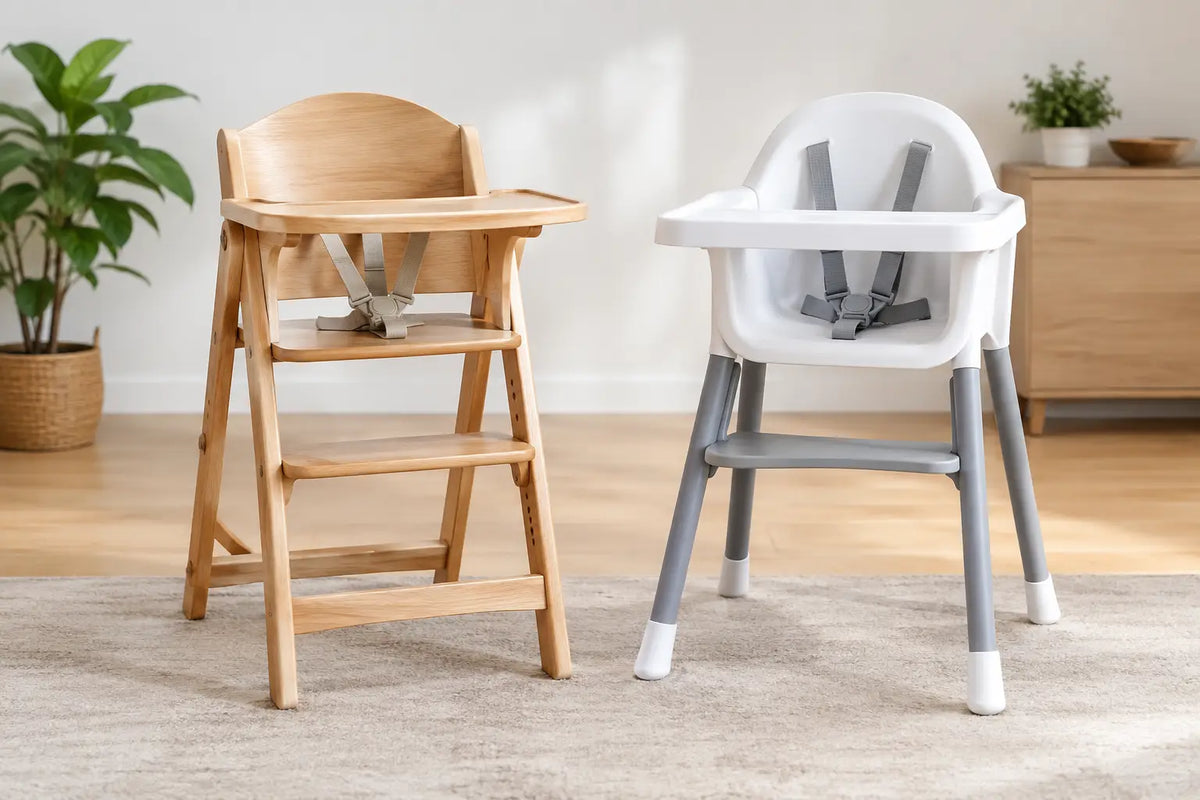
Look for a portable high chair with a five-point harness, a sturdy base and a seat that keeps your baby upright rather than reclined. Recline settings can be useful in some products, but for feeding solids, a more upright position is generally the safer choice. A footrest is often overlooked, yet it can help with stability and make self-feeding feel more natural.
Tray size is another practical detail. A tray should be easy to remove and clean, with enough space for plates, bowls or finger foods without forcing your baby to reach too far. If your family prefers baby to sit directly at the dining table, a chair that pulls in neatly can be useful.
For many homes, especially where space is tight or routines are busy, foldability and wipe-clean surfaces are not small extras. They make a real difference when mealtimes are part of a full day of naps, laundry, shopping and everything else family life brings.
Can a baby use a high chair before 6 months?
Sometimes parents see chairs labelled from birth or from the newborn stage, which can be confusing. These products often include a reclined seat for supervised sitting, but that does not mean a newborn is ready to eat solids in a high chair.
If your baby is younger than 6 months and not yet showing the physical signs of readiness, the feeding position is usually not appropriate for meals. There is also a difference between sitting in a baby seat for a short period and being ready to join regular mealtimes upright.
If you want to bring a younger baby to the table while the family eats, some adjustable chairs can be helpful for supervised use in line with the manufacturer’s guidance. But for actual feeding with solids, upright support and developmental readiness still come first.
Common mistakes parents make
One of the most common mistakes is starting because a product is available rather than because baby is ready. It is easy to set up the nursery, buy feeding accessories and assume the chair should be used straight away, but waiting for better head and trunk control usually leads to a smoother start.
Another mistake is relying on cushions, rolled towels or extra padding to make a too-big chair fit. If a chair needs a lot of improvising to support your baby, it may not be the right stage or the right model. Secure, built-in support is safer and simpler, while considering this a wooden baby high chair is the most recommended one.
Parents also sometimes leave babies in a high chair for too long outside mealtimes. A high chair is designed for feeding, not for extended play, lounging or napping. Once the meal is over, it is best to move on.
Making the transition easier
The first few sits in a high chair do not need to be long or perfect. Start with short, low-pressure mealtimes so your baby can get used to the new position. Let them explore a spoon, touch soft foods, or simply watch the family eat. This helps build comfort before expectations rise.
Routine helps too. Babies often settle better when they understand that bib on, chair buckle, tray down and mealtime all happen in the same order. It creates familiarity, which can make feeding feel less overwhelming.
You may also find that a few practical feeding essentials make a difference - easy-clean bibs, suction bowls, weaning spoons and a mat under the chair can save time and reduce stress. For parents building out a feeding setup, having everything in one place is genuinely useful.
High chair safety every parent should know
Always strap your baby in, even if they seem calm and not yet mobile. Falls can happen quickly, and babies often become more active with very little warning. Keep the chair on a flat surface and away from counters or tables they can push against with their feet.
Stay close throughout the meal and avoid giving food while your baby is reclined, distracted or half-slumped to one side. Check that fingers are clear when adjusting trays, and keep hot drinks and sharp utensils out of reach.
Clean the chair regularly too. Crumbs trapped in straps and joints are not just messy - they can make buckles harder to use and turn daily feeding into more of a chore than it needs to be.
So, when is the right time?
The right time is when your baby can sit upright with good head control, shows interest in mealtimes and can be positioned safely for feeding - for many babies, that is around 6 months. If your baby is not there yet, waiting a little longer is not falling behind. It is simply following their lead.
A high chair should make family mealtimes easier, safer and more comfortable, not more stressful. When the timing and fit are right, it becomes one of those everyday essentials that supports everything from first tastes to messy, happy self-feeding. If you are shopping for one now, choose a chair that works for your space, your routine and your baby’s stage - because the best setup is the one that helps real family life run more smoothly.